There is a version of Jesus often presented in soft tones and sentimental imagery, a fragile figure, reduced to a seasonal symbol, a quiet teacher whose death is remembered more for its tragedy than its cosmic meaning. This “Easter Jesus” is frequently portrayed as gentle but limited, profound yet ultimately contained within the boundaries of human frailty. But this image collapses under the weight of Scripture itself. The biblical witness does not permit such reduction. When the texts are allowed to speak in their fullness, they unveil something staggering: not merely a man who died, but the eternal, pre-existent power through whom reality itself holds together, stepping into creation and submitting to death.
To understand this, one must begin not at Bethlehem, nor at Golgotha, but before time itself.
“In the beginning was the Word, and the Word was with God, and the Word was God.” (John 1:1)
This is not poetic exaggeration. It is a metaphysical claim. The “Word” (Logos) is not a created being. He is not a later development in divine history. He is already there, before time, before matter, before energy. Modern physics tells us that space and time are intertwined, that the universe itself had a beginning, what we call the Big Bang. Every particle, every law governing motion, entropy, quantum fluctuation, all of it emerges from that singular beginning. And yet Scripture declares that before even that moment, the Word already existed.
“He was with God in the beginning. Through him all things were made; without him nothing was made that has been made.” (John 1:2–3)
Every quark, every galaxy cluster, every black hole bending spacetime, none of it exists independently. The force that binds atomic nuclei, the constants that allow stars to burn, the delicate balance that permits life, these are not accidents. They are expressions of a sustaining will. Colossians intensifies this:
“For in him all things were created: things in heaven and on earth, visible and invisible… all things have been created through him and for him. He is before all things, and in him all things hold together.” (Colossians 1:16–17)
Not only is creation initiated through Him, it is held together by Him. The Greek implies continuous action. If He were to withdraw, even for a moment, the coherence of matter would dissolve. The universe would not explode, it would simply cease to be.
This is the one who is later described walking dusty roads.
The scale of this should not be softened. Consider the observable universe: billions of galaxies, each containing billions of stars, separated by distances so vast that light itself, traveling at nearly 300,000 km per second, takes millions or billions of years to traverse them. The energy output of a single star dwarfs all human production combined. Yet Scripture asserts that the one sustaining all of this is not an abstract force, but a personal being.
“The Son is the radiance of God’s glory and the exact representation of his being, sustaining all things by his powerful word.” (Hebrews 1:3)
Radiance. Not a reflection, but an outshining. The visible manifestation of the invisible God.
And this radiance is not hidden in weakness. When glimpsed, even partially, it overwhelms human perception:
“His face was like the sun shining in all its brilliance.” (Revelation 1:16)
The sun, 93 million miles away, still blinds the human eye if stared at directly. Yet this is merely a comparison. A metaphor attempting to translate something beyond sensory comprehension into human language.
Even the highest created beings cannot fully endure divine proximity. Isaiah records:
“I saw the Lord, high and exalted, seated on a throne… Above him were seraphim… ‘Woe to me!’ I cried. ‘I am ruined!’” (Isaiah 6:1–5)
These are not weak creatures. Seraphim are described as fiery beings, yet even they veil themselves in the presence of God. And Isaiah, a prophet, collapses in terror. Not because God is cruel, but because His purity and glory are incompatible with fallen humanity.

Paul later writes:
“…who alone is immortal and who lives in unapproachable light, whom no one has seen or can see.” (1 Timothy 6:16)
Unapproachable light. Not metaphorically difficult, literally beyond access. This is not the language of a manageable deity.
And yet, somehow, this same presence becomes visible in Christ.
“He who has seen me has seen the Father.” (John 14:9)
This is the tension at the heart of the Gospel. The one whom no one can see is seen. The one dwelling in unapproachable light becomes approachable.
But not diminished.
When Jesus speaks after the resurrection, He does not present Himself as a mere survivor of death:
“All authority in heaven and on earth has been given to me.” (Matthew 28:18)
Not partial authority. Not symbolic authority. All authority, in heaven and on earth. Every dimension of existence falls under His dominion.
And heaven responds accordingly:
“Then I looked and heard the voice of many angels, numbering thousands upon thousands, and ten thousand times ten thousand… ‘Worthy is the Lamb… to receive power and wealth and wisdom and strength and honor and glory and praise!’” (Revelation 5:11–12)
This is not reverence given to a martyr alone. This is worship given to the center of reality itself.
The attempt to reduce Jesus to merely a physical man crucified in history collapses under this weight. Yes, He was crucified. Yes, He suffered. But to isolate that moment from the eternal identity of the one who suffered is to misunderstand it entirely.
It is like describing a supernova as “a bright flash” without acknowledging the stellar processes behind it. Or describing the laws of quantum mechanics as “strange behavior” without grasping the mathematical framework beneath. Reduction does not clarify, it distorts.
The crucifixion is not the story of a man overwhelmed by events. It is the story of the one who holds all things together choosing not to hold Himself back.
Isaiah foresaw this paradox:
“He was oppressed and afflicted, yet he did not open his mouth… like a lamb that is led to the slaughter.” (Isaiah 53:7)
Silence, not from weakness, but from restraint.
Paul explains the mechanism:
“Who, being in very nature God… made himself nothing… he humbled himself by becoming obedient to death, even death on a cross!” (Philippians 2:6–8)
This is not subtraction of divinity. It is the addition of humanity. The infinite does not cease to be infinite, it enters finitude.
Modern physics struggles with paradoxes: wave-particle duality, spacetime curvature, quantum entanglement. Reality at its deepest level defies simple categories. How much more, then, the incarnation? The infinite Word entering the constraints of human existence without ceasing to sustain the universe.
“For in Christ all the fullness of the Deity lives in bodily form.” (Colossians 2:9)
All the fullness. Not a fragment. Not an aspect. The entirety of divine reality dwelling within a human life.
This is the one who hung on the cross.
Not a powerless victim, but the sustaining force of the cosmos, choosing not to intervene.
When nails pierced His hands, the atoms in the iron, the molecules in the wood, the biological processes in the soldiers’ bodies, all continued to function because He upheld them. The gravitational forces keeping the earth in orbit did not falter. The nuclear reactions in distant stars did not pause.
And in that moment, all the immeasurable power, all the unapproachable glory, all the sustaining force of existence is not absent, but concentrated.
Creation continued, because its Creator willed it so, even as He was being executed within it.
This is the scandal and the glory.
“God was reconciling the world to himself in Christ.” (2 Corinthians 5:19)
Not sending another. Not delegating. God Himself entering the process of reconciliation.
And why?
“…who for the joy set before him endured the cross, scorning its shame…” (Hebrews 12:2)
The cross was not only pain, it was shame. Public exposure, humiliation, degradation. The one before whom seraphim veil their faces was stripped and displayed.
And He endured it.
Not because He lacked power, but because He chose not to use it.
This dismantles every weak portrayal. The issue is not that Jesus lacked strength. The issue is that He possessed immeasurable strength and restrained it.
Like compressing the energy of a star into a single point. Like containing the force of a galaxy within a human frame. Except even these analogies fail, because they deal with created energies. Here we are dealing with the source of all energy.
The narrative of Scripture does not allow for a “flaccid” Christ. It presents a being before whom kings, angels, and nations ultimately bow:
“That at the name of Jesus every knee should bow, in heaven and on earth and under the earth.” (Philippians 2:10)
Universal submission. Not forced by coercion, but compelled by recognition.
And yet,
The same Scriptures insist that this immeasurable reality was not imposed upon humanity in overwhelming display, but introduced in vulnerability.
Suddenly, the scale collapses.
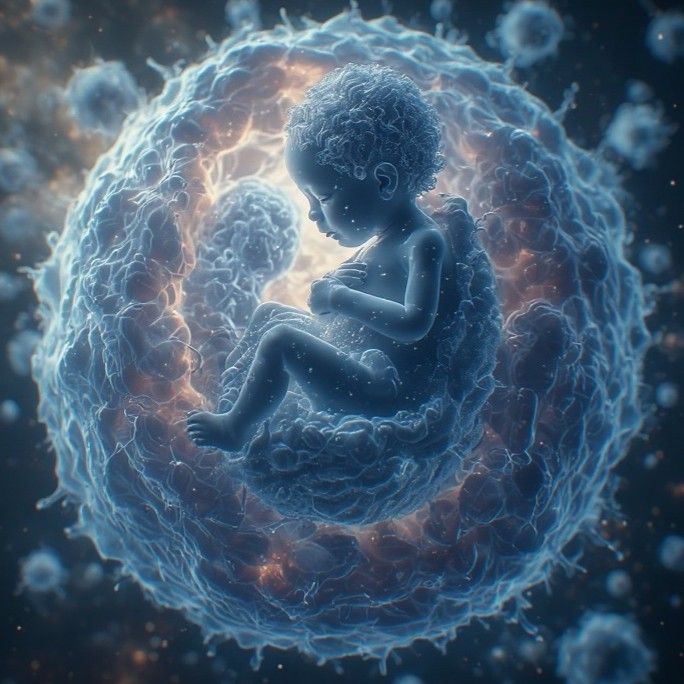
The one who inhabits unapproachable light… folds Himself into cellular division.
The one who sustains galaxies… becomes dependent on a womb.
The one before whom angels veil their faces… is born, held, and raised.
He grows.
He walks.
He hungers.
He teaches.
He is rejected.
And then,
He is stripped, exposed, and lifted onto wood.
Naked. Bleeding. Silent.
The architect of matter pierced by matter.
The author of life tasting death.
Focused.
Poured out.
The Son of Man, bearing the fullness of God, offers His life, spills His blood, and in doing so, opens the way: the infinite power of the Creator channeled into the forgiveness of sins and the doorway of salvation through baptism.
 Morganite's Blog