
The bible mentions money and wealth over 2000 times, more than faith and prayer put together! This highlights the importance of the subject to both God and man.
Net Gains

There have been some occasions in recent years where I have been asked to speak at church meetings about contributing financially to the work of the church. These are always pauses for reflection on my own motives for giving financially over the 30 plus years since I was baptized in 1990. In actual fact, when I was converted, I was chemically addicted and I had a net saving financially by obeying the teachings of the church. I calculated at one point, that over the year prior to my joining the church I had developed a £35 per week habit of chemical abuse including cigarettes, cannabis and alcohol. I believe that the 10% of my income that I decided to give to the church was actually less than this spending that I had enjoyed. Had I continued to use chemicals at that rate for the last 30 years I would have spent somewhere in the region of £20,000. 30 years of smoking would no doubt have taken it’s toll on my lungs and arteries and I may well have developed long-term health conditions or even died already as a result. My life overall was suffering as a result of my addictions. I was failing academically and I would certainly have had to live with this failure for the rest of my life had I remained substance addicted. Since I repented, I have been able to afford to travel and live a lifestyle that has given me a rich reward in experiences and relationships that I could not have had, had I continued in the lifestyle that I have grown accustomed to in 1990. Not only have I been saved from the consequences of my sin but the new lifestyle that I adopted as a missionary has been an exciting and full one to say the least. When I was first converted I did as any true disciple does and made a commitment to physically give up my life for what I had come to believe in; in Jesus and His death on the cross. During my travels as a missionary I have been blessed to have had the opportunity to have faced danger because of the gospel on more than one occasion. To be able to live a life with that kind of purpose fills me with confidence and joy. Compared to where I was at both emotionally and psychologically prior to my conversion, I cannot put a financial figure on what it was worth to me in terms of my life to be able to take part in the changes that I took part in, when I studied the Bible in East London with Chini and Alex. Along my journey and just as I entered the 21st Century with the rest of humanity I connected with my wife of 20+ years. I could never have held a marriage together had I married prior to my baptism. In my eyes, becoming a part of the Kingdom of God gave me my whole life.
Personal Investment.
Over the same period since I was baptized I have given 10% of my income as church contribution and together with my wife we have contributed a minimum of £75,000 in contribution over that period. Adjusted for inflation this is probably over £100,000 between the two of us. It may be slightly more than that as this is only a rough calculation.
Our church does not teach that 10% tithing is a New Testament command but does suggest it as a president. In actual fact I have regularly contributed approximately 15% due to lump sums I’ve given to fund the birthing of new churches all over the world. It was an affordable sacrifice to me while I was single. After I married in 2002 and subsequently increased my income it became possible to give more and in different ways.
This money given over to the church freely during the last three decades of our lives was given on a weekly or monthly basis as regular contribution as well as in 35 or 40 lump sums which were given annually as special missions contributions. This was a defining feature of our movement of churches between 1979 and 2003 in the ICOC and has continued in the ICC since 2004. It is attested to by the fact that 30 people who started to practice the biblical teachings of making disciples in every nation in our generation in 1979 converted 245000 souls in 171 countries in three or four hundred churches by 2003. That is part of my purpose in life. Thousands and thousands of people like me have contributed to the growth of the church by obeying God’s commands in the Bible. Hundreds of thousands of people have been impacted because of our giving. My giving practice ceased between 2003 and 2006. In January 2006 I joined the ICC. The rapid ICOC church numerical and geographic growth also stopped in 2003 amounting to the catastropic loss of 100,000s of souls.
Giving £75,000 over 30 years first to the ICOC over 13 years and since it’s demise as a movement, to the ICC, has not bought us our salvation. Our money is not what God was after all these years. We are very clear and have always been taught, that God does not need our money. He needs our hearts and he needs everything including our money to be devoted to Him. In hindsight, paying a large portion of my contribution to the ICOC before it was dismantled and disintegrated from 2003 onwards might have been very disheartening but after much bible study on the issue of ‘falling away‘ I do not feel that I gave this money in vain. I invested it with God. How could that be in vain. I look at my investment and I see a great return. I supported a church connected to God that first of all, saw nearly a quarter of a million souls added up until 2003 and that same body of Christ (now the ICC) is again focused and in step with the Spirit and moving toward the goal. I attended the former ICOC’s European Bible school in Budapest in 2005 having been given £500 by a rich American disciple from New England. I saw first hand how hard it was to recreate the unity the ICOC had prior to 2003. One evening after classes, I had a meal with leaders of the Berlin ICOC, Paris ICOC and a few others. It was clear that joining the cooperation churches was somehow linked to a 25% funding of their salary from churches in the US. This US investment secured the votes necessary to form a loose coalition of congregations but it has not been fruitful in producing a healthy church some 15 years later. ICC Evangelist, Blaise Feumba described similar ‘money for votes’ goings-on in his report when he joined the ICC in 2013. This heart in giving is very different to the one we had in the ICOC prior to 2003. The churches that I gave my money to, in the ICOC, were based in the United Kingdom and Ireland. We regularly had financial presentations which fed back to us how our money had been spent and often linked the amount of investment to the number of souls that were added to our churches. We had these presentations given in PowerPoint with graphs and charts, put to us in simple terms, easily understood by all the members. The church leadership felt that it was appropriate that they be accountable to the membership for representing the return on the investment clearly and truthfully. This is still the practice of the International Christian church and I am still satisfied with the return on my investment as I see us growing sufficiently rapidly (approximately 25%/year) to justify the level of investment.
Our 2020 presentation was in June. In the first 5 months of the year we have already seen 68 additions in European churches with a spend of £300k. The international Christian church measures its effectiveness in terms of its mission and therefore it is acceptable to state that on average each baptism has cost the UK church approximately £3970. Conversely, the ICOC European Mission Society had an annual budget recently of £1,800,000. It is not possible for me to estimate effectively the budget of contributed funds by European members of the ICOC. If one looks at the ICOC current membership in Europe and the 2.4% growth rate recently reported it is clear that their baptisms are costing 2 or 3 times that of those that are happening in the International Christian church. In addition their growth rate is many times less than that of the International Christian Church. This shows the International Christian church are getting more value for their money in terms of producing the fruit relevant to the Great Commission, the mission of Jesus to seek and save the lost. This is not only evident when comparing growth rates and cost per baptism. I myself am one of less than 10 people who joined the international Christian church in the UK as early as 2005 and 2006. We have literally seen hundreds of additions and the spread of Christianity to several European cities since we first joined the movement. We ourselves were not skilled ministers or Missionaries at the time when we joined but we were very faithful in terms of contributing funds to get Ministers on staff. We have reaped a great reward for our investment some 15 years ago. That is something that will be multiplied many times as the years go by given the growth rate and the return on the investment that people are making now which is in terms of coming up to 1 million pounds a year on an annual basis.

Money set apart.
The money of International Christian Church members is very clearly invested in the mission. This has the effect of helping other people to get salvation but also increasing the encouragement of those that are invested in the funds that are producing this fruit. Those that sow in tears reap in gladness. A church that is investing large amounts of money and not experiencing a harvest, is using money that is supposed to be devoted to saving a lost world, for the maintenance of churches focused on having a great lifestyle. This is not using the devoted things of God in the way that they were intended to be used.
In the ICC we live this lifestyle of devoting our money to the mission willingly. Our finances are a devoted thing. Taking the devoted thing and using it for something else, was also a sin that was committed by Achan (Jos 6:17-19, 7:1, 20-21, 24-26) and we see in the Scriptures that both he and his whole family received the sentence of capital punishment for having that sin in their household. Surely that should be enough of a warning for anyone trying to pretend that they’re building God’s Kingdom but at the same time using most of their resources just to have a nice family life.
Regular contribution, tithes and Special Missions offerings that have been collected since 1979 in my church are set aside and devoted to God. We fully expect that as these funds are devoted to God that God will use them to fulfill His purpose on earth to grow his church and help more and more souls be added. We treat this money as if it is a holy thing. The money itself is not the holy thing but what it is being used for is certainly a holy thing, the spread of the gospel. Much of it is spent in hiring staff, hiring venues and organising annual geographic conferences all over the world which fulfill many purposes to the movement as a whole and every individual in it. We who contribute, fully believe that our finances are blessed as a result of this giving.
We contribute according to the plans of our Evangelists (2 Cor 1:15-17, 2 Ki 12:9, 1 Chron 28-29) and needs of the Mission (Phil 4:19) and in accordance with our incomes (1 Cor 16:12, Deut 14:22, Mal 3:10) so that there can be equality (2 Cor 8:13-14). Our Evangelists are ambitious (Rom 15:20) and work hard (1Thes 5:12) to win souls.

Value for money.
I believe that our pay structure is fair. If anything, we do not pay our ministers enough when taking into consideration the number of hours that they work and the lack of benefits that they have in their salary packages. There is a significant contrast between what I see as the return for my investment in the ICC and what I’m seeing reported by the former ICOC churches.
In 2017 the cooperating service teams of the former ICOC churches asked the following question.
7. Do we need a global missions organisation to strengthen our missions societies?
Only 62% of the former ICOC church’s leadership believed that a central leadership was needed for coordinating its Missionary societies. The state of the existing Missions Societies is weak. This is why the question was asked regarding ‘strengthening’. For example, the budget in recent years for the European missions society was approximately $2 million (£1.5m) but this is not producing a growth rate worthy of the investment. This strengthening question was surely linked to the former ICOC churches 1.9% membership growth rate reported by Gordon Ferguson for the year 15/16.
As of March 2020, there are fourteen mission societies that the former ICOC uses to divide the world geographically for alledged evangelisation. Five have no current website to show their impact. Two have no Web presence. Five of the remaining seven use information and statistics that really demonstrate the impact of the great sacrifice made by ICOC members like myself between 1979 and 2003. These societies collect money for ‘evangelisation’. They advertise churches in need of support to evangelise their geographical regions of the world. In many ways they are restating and reclaiming the victories of the 1980s and 90s and maintaining those church’s needs as well as meeting the needs of their campus age children. Some missionaries are being circulated around smaller congregations but the results are nothing like those of the former investments prior to 2003.
The Chairman of the board of the European Missions Society for the former ICOC churches recently said the following in a promotional video:
“The purpose of the EMS [European Missions Society] is to evangelise Europe… Half a billion people… It requires a lot of resources to make an impact for God… The Boston Church sent the first Mission Team in 1982.. It clearly is a goal of the EMS… to plant more churches so that more and more souls would be converted.. Current budget of $2,000,000 per year… It’s exciting to see… “

Money management.
It is understandable that leaders of former ICOC churches at the local geographical level do not want their Missions Societies to be managed centrally. The figure falls locally to only 54% wanting central management of the administration of missionary funding. It is hard for the members of former ICOC churches to put their faith in central management of funding for evangelization. This is hard for mainly two reasons. Firstly, their is no example in the former ICOC churches worthy of such responsibility. Secondly, the management model that has been employed by the former ICOC churches is cooperation. The membership and leadership have become very accustomed to having a great deal of local autonomy.
Having a central management of missionary funds (as is the case with the International Christian Church) is part of the powerful biblical model epitomised in the following scripture:
2 Corinthians 8:13-14 Our desire is not that others might be relieved while you are hard pressed, but that there might be equality. At the present time your plenty will supply what they need, so that in turn their plenty will supply what you need. Then there will be equality,
The evangelization of the world is done under the the leadership of Evangelists and though this may seem to be an obvious point the training, appointing and funding of the ministries of these Evangelists is one of the key features of church growth.
Romans 10:14-15 How, then, can they call on the one they have not believed in? And how can they believe in the one of whom they have not heard? And how can they hear without someone preaching to them? And how can they preach unless they are sent? As it is written, “How beautiful are the feet of those who bring good news!”
Dont forget this central administration of finance made possible by the rise of international finance, was the model of the ICOC when it started with 30 members in 1979 and it led to the converting of nearly a quarter of a million souls of which I was one. This represents growth of approximately 25% per year allowing for the 2000 or so precious souls who grafted in from the restoration movement! This exact same process is literally repeating itself in the ICC.
The ICC is advancing more than 10 times faster than the former ICOC churches in terms the evangelisation of the world. That’s value for money. The International Christian Church has a centrally organised training programme called ICCM (International College of Christian Ministry) which has already recruited and graduated hundreds of missionaries from all over the world to have special training for the ministry and to be ‘sent’ and ‘to have feet that bring the good news’. It draws on those who have acquired ICCM Degrees for the recruitment of ministry staff and Masters degrees to propagate this Company of the Prophets, all around the world. For example, two years ago, in 2019, ICCM got started in the United Kingdom. It is not possible in the former ICOC churches to have such an organisation at this time due to the lack of central leadership.
The former ICOC churches’ questionnaire in 2017 asked questions as follows,
10. Do we need an organisation to manage resources, like people and money, globally and regionally?
There is a huge divide on this issue of organising people and money. The speech of the people is confused. 55% of leaders do not want people outside their sphere of influence interfering with their decision making or planning regarding their finance or leadership personnel. The 2012 conference in San Antonio also highlighted this position. It was significantly galvanised by one speaker who reassured his peers that no-one could come in from outside and sack him! By ‘outside’, he meant another leader from a former ICOC church or service team. Smaller churches complained at this conference that they were not being supported by the larger churches even within the same country. The following question also highlights the difficulty within the former ICOC churches of solving the problems created by their cooperation model.
9. Do we need a structure for conflict resolution on a global and regional level?
63% of individuals in former ICOC church’s current leadership want a conflict resolution structure. Again this is a reflection of the Babel-onians as I detailed in Part One of this article. God’s judgement on the Babel tower builders for their great wickedness was to scatter them across the world forcibly by causing them to not be able to communicate with each other. It is also clear from the publications of the former ICOC service teams, that there is still a lot of conflicting ideas within the former ICOC churches.
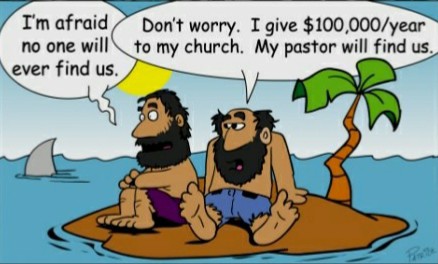
Why even give ANY money to the church?
Skeptics ask ‘Is tithing a ‘NT command’?’ Read the scriptures referenced above. This is a non question. Our Evangelists have a plan to plant churches in all the strategic locations around the world and this requires finance which they break down to us and we do our absolute best as individuals to meet this need that the world has for our church. This is not a question of tithing but giving as much as we possibly can! The concept of making sacrificial pledges is a biblical one, both before and after the law of Moses. Tithing was a minimum contribution under the law and the whole system of worship was supported by additional offerings. This is obviously not the same heart that the former ICOC churches have at this stage. I look at the substantial investment I made in the ICOC and it is only paying off within the accounts of the ICC. The former ICOC churches are not growing sufficiently to display anything like this kind of heart towards the lost world. That is a sad thing. That is not a boast. That is a sad thing. To give an example regarding how insignificant the 10% tithe is, in the overall scheme of our giving, consider the expectation we have of our campus ministry when it comes to Special Missions. There are some campus students that are on very low incomes. In such cases if they are giving £1 a week contribution they would not be asked to contribute £15 for a Special Missions Contribution but something more like £75. This is easily achievable through a sponsored event or a special focus of doing work of some kind. Many students do this for other causes. By so giving in this way our students demonstrate the heart to make a special effort and in so doing help the whole church to achieve the mission that Jesus left us to evangelize the world. Special Missions Contribution organised centrally and with centrally coordinated distribution has resulted in all of the ICC plantings around the world each year. Everyone in our congregation sees this growth and gives financially because they are inspired to do so. The state of the former ICOC churches’ Missions Societies shows a different spirit entierly.
If we take the stats available as estimates over the last few years and apply the percentages made available by Gordon Ferguson then, recently in Europe an approximate former ICOC budget of £1.5m led to an estimated total of 140 additions to the 5000 members in European cooperation congregations. Each addition cost a minimum of £10,638 (not including local church contribution which could more than double the cost). By way of contrast the ICC cost of each addition was approximately £3970 in Europe. So ICC baptisms are a bare minimum of two and a half times cheaper than the Former ICOC churches and ICC baptisms are following the explosive percentage growth pattern that the ICOC had prior to 2003. If you’re in the ICC you are getting bang for your buck!
When I visited Portland Oregon in January 2006 to investigate the continuity of the ICOC that was going on in that city, I met people from all over the world who wanted to get back to making the sacrifices of devoting finances and seeing a world evangelised. I saw examples of businessmen turning over houses and using the profit to fund the mission. I saw newly appointed ministry staff (former lead Evangelists) making five figure donations to part fund themselves in the ministry. I also had lunch with an airline pilot who had travelled from the former ICOC church in Berlin. It was his first meeting with the brothers in Portland. In the middle of the conversation he pulled out a booklet about how to help churches grow which I had heard referenced at the ICOC’s European Bible School approximately 6 months previously. This was typical of what was going on in the ICOC churches in 2004-2006 and for some time afterwards and even up until today. They have been bringing in consultants and people from other denominational backgrounds that do not teach correctly, the gospel in the Bible and asking for help to structure their churches appropriately. This obviously has not worked either. The strategy of looking at other denominations and asking their experts to come and give congregations a plan to recover is similar in nature to what happened to the Israelites when they wanted a king (1 Sam 8:19). The Hebrews at this time had reached a point when they wanted to have a leadership structure more in line with the world around them. Similarly, the former ICOC churches looked at the leadership strategies and structures in other groups around them, in this case, the churches, and decided that they wanted to have this kind of thing for themselves. This did not work out very well for the Israelites either. God said by choosing the leadership structures of the world that Israel had literally rejected Him (1 Samuel 8:7-9,18-19, 1 Samuel 12:17-21, 25). By choosing a king they rejected God and received the due penalty!

Put your mouth where the money is!
Come and talk to us. If you really want to fund the evangelization of the world, give us your money! The international Christian church is a group of people ready to be scattered over the whole earth not as a punishment but as a willing sacrifice to take the gospel to every nation as quickly as possible in our generation. Anyone who still believes in this concept within the former ICOC churches should join the International Christian Church. It is the only church that we know of in the world, that teaches the true gospel and also has an effective plan to evangelize the world. If you want more bang for your buck join the ICC. If you are in the Former ICOC churches and you want to see what consistent, worldwide 25% growth looks like, visit the ICC. You’ll be swamped by fired up young Christians and Evangelists baptised only 5 or 6 years ago, but that’s a good thing right?! Why settle for less and die in Haran like Terah (Gen 11:31-32) far away from the promised land? Why lose our life like Achan by taking the devoted things? Be with a church where you can devote the offering that can evangelise the world! Don’t end up like Gehazi who we find fallen away years after witnessing miraculous resurrections because like Judas (Jn 12:4) he wanted to accumulate a little wealth and prestige rubbing shoulders with kings telling the old stories of glory days (2 Kings 4:26-27, 2 Kings 5:19-27, 2 Kings 8:5). His leprosy marked him as cursed but he was still bold in his selfish ambition! When Elisha had been alive Gehazi had tried to block the Shunamite woman from even seeing the prophet (2 Kings 4:27). 7 years later he acts as if this had never happened. No apology. Just ushers the woman in as proof of his great boasts. How convenient it must have been that she showed up at the moment he was talking about her. There really is no point in the accumulation of worldly wealth at the expense of the Mission. Fundraising based on the victories of the 1990s is futile. The Former ICOC churches grew tired of funding effective missions nearly two decades ago. Gordon Ferguson said in his book ‘My Three Lives’, ‘We will never go back to that’. It’s time for the former sons who have said ‘No, we will not go to the Vineyard’ to ‘change their minds and go’, (Mt 21:28-31) and get more bang for their buck.
 Morganite's Blog