
People sometimes fall into the trap of lauding the smallest victories of the Protestant reformers and missing how they were usually some of the worst persecutors of God’s people, the little flock (Luke 12:32, Mt 7:14). As a Catholic, I’d heard of John Knox in R.E. class at school. I was generally taught by either Catholic nuns or priests. My history teacher, who taught me about the Reformation as part of my O-level in 1986 was a committed and religious Catholic woman and I don’t ever remember hearing her teach me about John Knox. She must have done though, because the Presbyterian Church is huge in Northern Ireland, since the first decade of the 1600s, due to the plantation of thousands of proto-Presbyterians in Ulster by King James VI Scotland aka James I of England (King James Bible 1611). So the only thing I knew about John Knox up until 1990 was that he started the Reformation in Scotland (which I have since found out to be untrue (Mt 22:29)). As a young person, I was aware that Presbyterians were generally Protestants, didn’t say The Hail Mary and didn’t believe in the Pope. As a Northern Ireland Catholic, I grew up hating Presbyterians but not because of John Knox or any other belief that they held from the Bible. I had no clue about predestination or any of the five points of Calvinism. I only believed that they ran the police and the British Army’s Ulster Defence Regiment (UDR) and that they were responsible for the oppression of Catholics for 400 years and I believed that they ran the Masonic Orange Lodges. That was it. That was the sum of my knowledge about Presbyterians. I stopped hating Presbyterians, in 1990 by the way! I was unaware of the specific influence of John Knox on Presbyterianism until church history classes I attended from 1990 onwards. But it wasn’t until I was preparing to move to plant a church in Scotland in 2021 that I understood how much Knox hated my people, the Anabaptists! The Anabaptists he met believed, as my church does, in free will and that predestination in scripture is only God’s fixed, preset judgment process and not God’s arbitrary judgment in advance (Acts 17 26-27).
In his paper, ‘An answer to a great number of blasphemous cavillations‘ Knox pours out bitter rebukes on their teachings,
He is full of fire and brimstone for the Anabaptists repeatedly likening them to snakes and their teachings, venom.
‘How blasphemous be your similitudes!’ (p64), ‘For as you being infected with heresy, malice, and envy, did willingly write and utter your venom..’ (p122), ‘As your cogitations of God be grosse and carnall, so be your iudgemeenes in this place of scripture decevable and most erroneouse.’ (p176)
‘But if your cogitation and foolish conclusions of his eternal Godhead be (as alas too manifestly ye declare yourselves) so profane, so carnal, and so wicked, that long you abiding in the same, cannot escape God’s just vengeance. Repent before that in his anger he arrest and declare that your justice, where of so much ye brag, is manifest blasphemy against his dear Son Christ Jesus. God the father of our Lord Jesus Christ preserve his small flock, from your pestilent venom, and most dangerous heresies, and stop your blasphemous mouthes, that thus dare jest upon God, as if he were one of your companions..’ (p131/2)
He threatens them with the law courts (Luke 21:12) and the charge of blasphemy which often brought with it the penalty of death as we saw from the burning of Pavel Kravař in 1433 at St Andrew’s by Scotland’s Archbishop Henry Laidlaw.
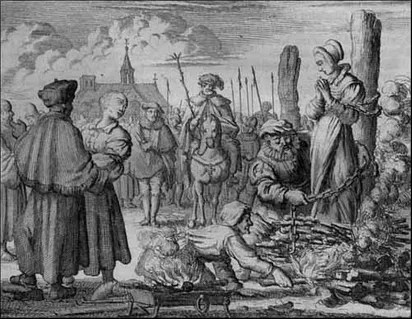
‘But seeing that thou and thy most pestilent sect, be not content maliciously to slander those that in such a case be most innocent, but that also with most impudent mouths ye vomit forth your horrible blasphemies against God’s majesty, I will most earnestly and most unfeanedlie require of all rulers, Princes, Magistrates, and governors who in the fear of God do rule, above their subjects, that as they will answer in the presence of the Lord Jesus, for the administration of justice committed to their charge, that indifferently they judge betwext you and us. To wit that if we can evidently be convicted, of those crimes which ye most maliciously, and most unjustly lay to our charge, that then judgment without mercy be executed against us. But and if ye fail in your probation, and also if ye can not prove cruelty to be in God’s works, supposing that our doctrine remain (as that it is) true and stable, that then such order may be taken, for repressing of your venomous tongues, that neither ye be permitted thus openly to blaspheme gods Majesty, neither thus maliciously to slander innocents, and to offend ye ears of all godly hearers.’ (p153)
Since becoming someone who practices the Bible and who has attempted to set up Bible studies with quite a few Presbyterians and other Protestants in Northern Ireland as part of my role there, starting churches in 1993 and 2000, I was surprised to say the least, to find that the Calvinist, Protestant, Presbyterian salvation doctrine so easily and obviously contradicted clear teachings in the Bible. I always held the false assumption that Protestants knew the Bible well, and well enough to not be so easily deceived as to believe in something as simple as the false teaching of salvation by ‘Faith Alone’ (Js 2:24). I quickly understood when talking to Protestants on the street that they were usually just as unwilling and unlikely to sit down and look at the Bible with me as Catholics. To this day that still creates a feeling of disbelief in my mind and heart. Catholic children were so easily deceived in this respect when I was growing up in Northern Ireland. When we saw the ‘Bible Bashers’ on the street singing Jesus songs and playing accordions and then shouting into microphones or loudhailers about Jesus we just assumed that they knew the Bible very well. Many assumed also, that all Protestants were like that. Many still assume that Protestants know their bibles. John Knox represents the source of Reformation and the reformed doctrine of salvation for the many Protestants in Scotland and also in Northern Ireland (because of the Ulster Scotch ethnic group) and essentially to Presbyterians all around the world.
Here is a brief layman’s summary of the life of John Knox. John Knox grew up 20 miles outside Edinburgh and became a Catholic priest in 1536. This was just five years after Simon Fish was arrested as an Anabaptist in a London Anabaptist Congregation and four years after the Anabaptist, James Bainham was burned in Smithfield in London. So these brothers died while Knox was at seminary. Knox was radicalised by Protestant reformers and ready to kill in the name of God, himself bearing a two-handed Claymore, Braveheart-style sword and acting as the bodyguard of a key reformer in Scotland in 1545!
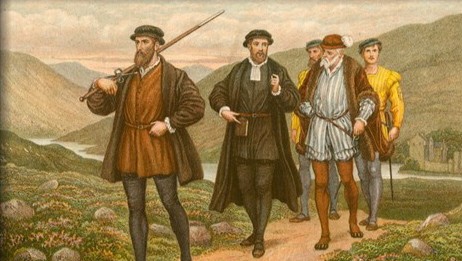
He began secretly preaching the Faith Alone doctrine in 1547 whilst a fugitive. He was captured by French troops (intervening on behalf of the Catholics) and then became a slave on a Galley ship for 19 months as punishment. After he was freed, he preached in various appointed positions as a reformed preacher in England until 1554 when the new Queen was Catholic, and he was forced to go to join Calvin in Geneva to avoid persecution. His position in the English-speaking church there led him to hash out various conflicts he had with the reformed church in England and he eventually settled with his own brand of Protestantism. He returned to Scotland in 1555/56 briefly and then back to Geneva where he wrote a widely circulated letter condemning the practice of females acting as ruling monarchs. His return to Scotland in 1559 led to the raising of armies and his preaching at multiple churches (including St Andrews), led to riots and vandalism.
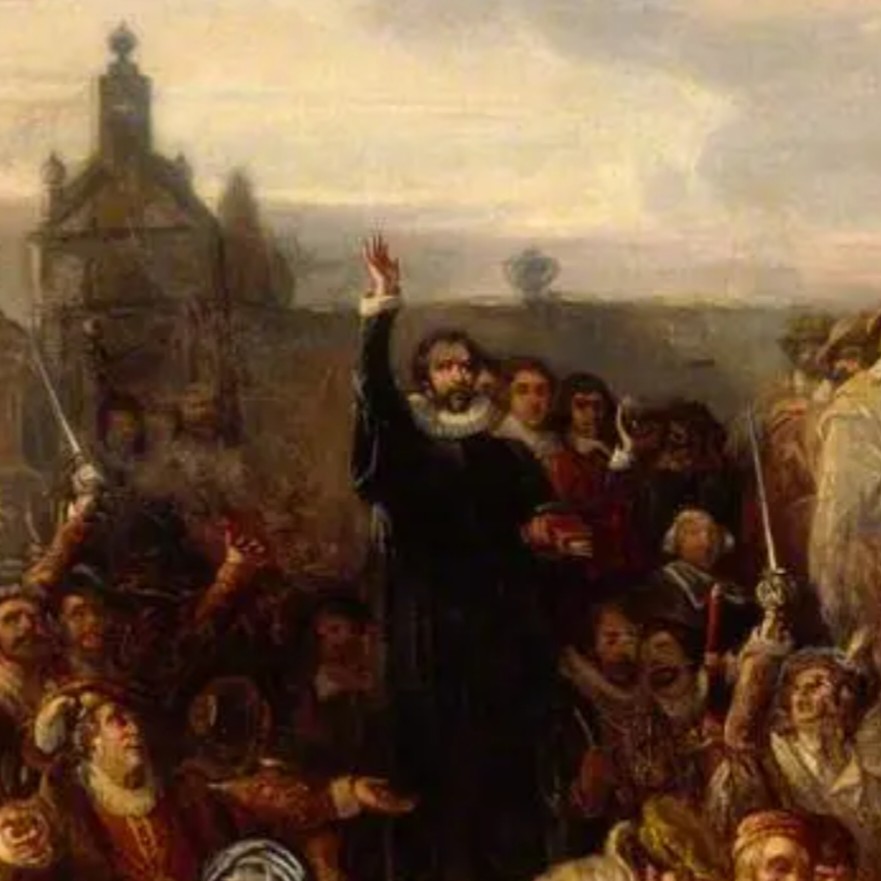
Between that time and his death, he was involved in the writing of many documents that eventually influenced the official legal creation of the Presbyterian denomination in Scotland in 1689 (120 years after his death). He died on 24th November 1572 aged approximately 58 years old. It is noteworthy, that 140 odd years after the formation of the Presbyterian denomination that it was two of Knox’s followers, Thomas and Alexander Campbell (realising the falsity of their doctrine), that started The Restoration Movement, in the United States, the most recent revival of which, is the International Christian Church.
He had great influence during his life as a chief reformer and wrote one particular paper of great interest to me as an Anabaptist. Below is a summary of that paper. It is entitled ‘An answer to a great nomber of blasphemous cauillations written by an Anabaptist, and adversarie to Gods eternal predestination’ (spelling in 16th Century English). In this paper John basically takes apart a short book written by an Anabaptist author who is unnamed. The book is briefly described by academics as follows:

[Though ‘An Answer’ is a lengthy treatise, it is far from being a systematic one. Instead of developing an orderly argument, Knox assailed the Anabaptists book, chapter by chapter. The result was repetition, and repetition that was not always consistent with itself. In his haphazard approach to predestination, Knox clearly leaves the impression that he was not truly at home in the subject.
(John Knox Confronts the Anabaptists: The Intellectual Aspects of His Encounter RICHARD G. KYLE*)]
A question instantly popped into my mind when I read how much Knox knew about the anabaptist doctrines (knowing that he had access to their documents in England and in fact allegedly was personally given this document by this Anabaptist in London in 1559). This was the question of whether there were Anabaptists in Scotland at this time? We have already presented clear evidence that they were prolific in England.
The first thing one can consider when thinking about this, is that there was no physical border like an ocean between England and Scotland. One can see from Anabaptist history, in almost every century, that they were usually an international movement. Key persecutors of the Anabaptists in England in the British Government and Divines of the church of England give us the best sources of evidence that my brothers and sisters were abundantly fruitful in England in the 1500s and 1600s. There are, of course, opinions to the contrary. There are some that say that Anabaptists and Anabaptism, as it were, didn’t arrive in Scotland until Cromwell’s army came to Scotland in 1650! Another idea that is put forward about Anabaptists in Scotland, is that they only started arriving there or spreading their teaching there in the 1500s due to the Reformation and the start of the Anabaptist movement by Conrad Grebel in Geneva in the 1520s. One only has to look at the fact that prominent Anabaptists had already been burned in Scotland in the early 1400s to understand that both of the above views are poppycock. I’ve already written about Pavel Kravar in my article about Orthodox Christianity in Scotland.
There is also another phenomenon with Anabaptists to consider. First of all, it’s important to understand that they were called heritics largely because their Catholic opponents falsely accused them of believing in two baptisms.
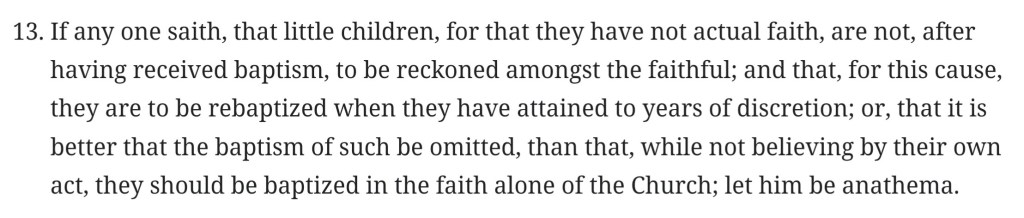
One of the distinguishing features of the Anabaptist movements in all the centuries up until the 1660s, which was not apparent from their name, was that they were executed for being heretics usually by burning, beheading or drowning. Both men and women were executed. Sometimes those that were just studying the Bible who had not yet been baptized were also executed if they refused to recant. They were hunted, they were tried and the courts usually kept detailed documents about their inquisition which are still available in the town halls of France, Germany, Holland and other European countries. The fact that they were practicing what was thought to be a religion that brought the punishment of death meant that they often did so secretly and spread their teachings in a covert way. Their numbers were often swelled by members of the poor or professional communities. It was usual that their localised fame and persecution resulted in some educated convert becoming quite prolific in their evangelism or writings and subsequently, so many people were then converting that it became much harder to hide their meetings and other activities. When this happened and prominent persons were arrested, the fame of those individuals and their ranking in society meant that more of a fuss was made of the arrest and the execution. One example of this which I will talk about in a different article is that of Peter Waldo originally converted in Lyon in France, but who ended up quickly on the run in various other countries. Much useless debate has ensued around whether the people who he converted (and their spiritual descendants) were labeled Waldenses because of his name or because of the fact that they came from some ‘valleys’ in the mountains. It seems much more likely to me, given that he lived in the city of Lyon and was a protagonist of that movement (that preexisted his conversion), that the followers after that time and after his execution were called after him by their persecutors. In order to flee persecution they crossed the border from France split into 3 groups and went into different countries. This is a good example of how Anabaptists were no respecter of national borders. They were, after all, illegal in most countries. So there is every reason to believe that the presense of undocumented Anabaptists in Scotland prexisted Paval Kramers execution in 1433, and John Knox’s letter against them in the mid 1500s. I believe also that they were regularly established in Scotland in the centuries where we see their executions documented in England. I make this very same argument about the Primative Church in Scotland in my article on Scottish Orthodox Christian movements. Namely, that the presence of early Christians in the first 4 centuries does not depend on the building of expensive stone wall churches with adjoining graveyards dated from the 450s onward. Even the Vatican museum in Rome has virtually nothing surviving from the first and second century! Almost 1000 churches have been planted in God’s modern-day movement and less than a tenth of 1% of them ever owned a building! The evidence of the existence of disciples in any generation is certainly not buildings. Moreover, we are not seeking out the authorities, to give up our lives to the fire or sword as our primary method of carrying our cross every day! Therefore it is safe to assume that many of the members of the persecuted movements of true Christians have simply passed under the radar of History, and in most cases, quite deliberately by evading capture! The judgments of a number of Vatican councils and laws made in Protestant countries also demanded the destruction of Anabaptist books and pamphlets in addition to their execution.
Coming back to John Knox. His 477-page document condemning Anabaptists generally lumps together the Anabaptists with a number of other actual heretical teachings. He identifies these teachings by the leaders that taught them. The Orthodox Anabaptists, who were widespread all over Europe had this problem historically, where they were branded heretics and then also lumped together with all the other heretics. I understand this way of thinking. When I was a Catholic in Northern Ireland, if I met someone who went to church and they weren’t Catholic, then I assumed that they were Protestant. Again, after I converted to be an Anabaptist I was often regarded by Catholics to be Protestant. Of course, nothing could be further from the truth. The Anabaptists went to some lengths to distance themselves from heretical sects and especially one particular small group of misguided Anabaptists in Munster in Germany. This one in particular, was heavily influenced by a recent convert to Anabaptism. This is what Thieleman J. van Braght wrote in his book Martyrs Mirror in the introduction about that group: “the Munsterites,* etc.; whose fabulous faith, life and conduct, the true Anabaptists have never recognized”. Yet Knox projects his view that this one erroneous group in one city defined the Anabaptist Orthodoxy for all of Europe and beyond!
So Knox held my sect in contempt. He did not found or start the Presbyterian church, he was ready to kill and imprison for the reformed doctrine of Calvin, he was a prolific writer and persecutor of my church! He simply couldn’t leave us alone. He had to write 477 pages of vitreolic ranting before he got us out of his system. It is not surprising that his notional followers will feel similarly towards us, nor strange that their language will be as repetitive and as twisted as his was. But Knox just like other authorities did not follow the advice of Gamaliel..
Acts 5:34-39
But a Pharisee named Gamaliel, a teacher of the law, who was honored by all the people, stood up in the Sanhedrin and ordered that the men be put outside for a little while. Then he addressed them: “Men of Israel, consider carefully what you intend to do to these men. Some time ago Theudas appeared, claiming to be somebody, and about four hundred men rallied to him. He was killed, all his followers were dispersed, and it all came to nothing. After him, Judas the Galilean appeared in the days of the census and led a band of people in revolt. He too was killed, and all his followers were scattered. Therefore, in the present case I advise you: Leave these men alone! Let them go! For if their purpose or activity is of human origin, it will fail. But if it is from God, you will not be able to stop these men; you will only find yourselves fighting against God.”
Instead, Knox spent day or weeks persecuting us and gave us the best evidence of our presence in Scotland that we could have. He simply couldn’t ‘leave us alone!’ He followed neatly and fervently in the footsteps of the Catholics and Protestants before and after him and indeed up to this present day! Sadly, John Knox, although a prolific Bible preacher, was a false prophet and a heritic that has given generations of Protestants false hope that they had a man of old! His writings led the proto-Presbyterians astray and those that now follow his doctrine as well, in modern legal Presbyterian churches. I can only hope and pray that seeing that he himself was so vehemently against us, proves that we are an old sect worth taking note of, and worth investigating, for indeed we have always been here in some shape or form before and after Knox. Indeed Knox may turn in his grave to realise that as I write this now, a true disciple and Anabaptist man lives and breathes and shares his faith in the Scottish town of Haddington from whence John Knox came!

 Morganite's Blog