
A burned bridge is not easily rebuilt.
Picture if you will, a paedophile who is a member of your physical family and you find out this man has abused one of your children in a single instance of serious sexual abuse. Now imagine that this man has given personal details and the whereabouts of a number of other children in your extended family to his paedophile ring, because of his trusted position, and these children have been preyed upon, using that information, and two of these men seriously abused two children multiple times and one of the children was killed in the process. Now imagine that this same family member is extremely sorry for what they’ve done, and makes a huge turnaround working for charities and giving information regarding pedophiles to the police and even infiltrating paedophile rings and bringing them to justice. Would you then allow that family member back amongst your family?
You have put yourself in the position of Novatian. Born around 200AD during the reign of the Roman Emperor Septimius Severus. Novatian would have remembered the Emperor appointing his two sons as co-Emperors (their reign depicted in the 2025 ‘Gladiator 2’ movie, Emperors Caracalla and Geta). Novatian lived through Caracalla murdering Geta in 211AD. Novatian was a Christian in Rome. As a church leader Novatian had to decide whether to let those who had engaged in the Emperor’s pagan worship ceremony, be allowed back into the church during The Great Persecution.
After Caracalla, Novatian lived through the reigns of Macrinus, who reigned until 218 AD and thirty more years of subsequent emperors including Elagabalus, Alexander Severus, Maximinus Thrax, Gordian I, Gordian II, Pupienus, Balbinus, Gordian III, Philip the Arab, and Decius (249-251AD). During these 10 reigns Novatian became the singular, foremost, apologetic intellect of the international church throughout the known world and is universally recognised for his accurate and widely referenced written teaching on the Trinity.
Novatian witnessed Decius’ ascent to the throne of the Empire and issue the first ever Empire-wide edict to arrest, torture and murder his church members. He saw Fabian the leader of the church in Rome martyred (one of the first to be arrested), January 20th 250AD, for refusing to pour the drink offering and eat the sacrificial meat. Novatian probably also personally knew the other prominent disciples who were martyred in Rome in 250 and 251, Jovinus and Basileus and the young women Ruffina and Secunda as well as many others. Novatian eluded arrest and lead the church in Rome in secret together with two other leaders. It is clear that the edict of Decius did nothing to stop the church as seven years later in 257AD and again 258AD Emperor Valerian issued an edict targeting church leaders for execution without trial.
Cyprian of Carthage (Epistle 81.1, c. 258 AD):
“Valerian has sent an even harsher decree: that bishops, priests, and deacons must be put to death at once.”
Acts of Cyprian (describing his trial and execution, September 14, 258 AD):
> Proconsul: “The most sacred emperors Valerian and Gallienus have sent letters commanding that those who do not follow the Roman religion must die.”
> Cyprian: “I will not do so.”
> Proconsul: “Then you shall die by the sword.”
It is thought that Novatian was martyred during this Valerian persecution.
The road to hell is paved with good intentions!

“To the officers in charge of the sacrifices of the village of Alexander’s Isle,
from Aurelius Diogenes, the son of Satabus, of the village of Alexander’s Isle, aged about 72, with a scar on his right eyebrow.
I have always sacrificed to the gods;
and now in your presence, according to the commands, I have sacrificed and made a libation and tasted of the victims; and I desire you to subscribe.
Fare ye well.
I, Aurelius Diogenes, have delivered this… I, Mys[… the son of …]non, [saw him] sacrificing, and have subscribed.
In the first year of Imperator Caesar Caius Messius Quintus Trajanus Decius Pius Felix Augustus, on Epiphi 2 (= June 26, 250).”
Between 251AD and his martyrdom in 258AD Novatian not only led the church in Rome, evading capture but made the decision that christians who offered the sacrifices to the Roman gods, could not be readmitted to the church. This caused a split with more liberally-minded leaders who felt that those who recanted their faith on pain of death should be accepted back. I have seen this thinking in my own church in 2008 when my minister felt that my own restoration to the church should be held off until I demonstrated sufficient trustworthiness. Indeed there were those who heartily disagreed with his decisions that had me attending, tithing, bringing multiple converts to be baptised and restored but not receiving membership for over a year. Some though it harsh. The gentleman had his reasons. He had a small new group where every member mattered and he saw it as protecting them from the influence of someone (me) who might harm their faith. Sadly at this time he is no longer in leadership for similar decisions. Nonetheless, my own experience taught me that unity sometimes comes at the cost of a prolonged hardship and I believe it was worth it, as the church has since experienced massive growth under new leadership, brought in short weeks after I was restored. Similarly, I have regularly seen cases of candidates held off from baptism or restoration for days, weeks or months (and longer) due to issues that needed time to change such as addictions or living situations or just reluctance on the part of the candidate to make a crucial decision or a change in theology. Not all delays are based on right judgement. Holding people off to provide inspirational moments at conferences and big events is something that was identified in my church as unscriptural.
Compare this situation with my Pedophile example above. A pedophile responsible not only for the molestation but the death of innocent children. Can he come back to the family? And can we compare this paedophile to a disciple leader of a church who spills out a small drink on the ground and eats a piece of meat and says a few words to the Roman gods to stay alive, and avoid joining his church members who refused and were brutally tortured and murdered by the Romans. What’s the harm in recanting? Consider God the Father of His children who wants those children to win the whole world to live righteous lives and having provided purification from sin by His Son’s willing death on the cross, and consider also Christ, now waging war against Satan for the souls of all men.
Let’s consider the words of Jesus here briefly.
Luke 14:25-27
Large crowds were traveling with Jesus, and turning to them he said: “If anyone comes to me and does not hate his father and mother, his wife and children, his brothers and sisters—yes, even his own life—he cannot be my disciple. And anyone who does not carry his cross and follow me cannot be my disciple.
Matthew 10:5,23
These twelve Jesus sent out with the following instructions: “Do not go among the Gentiles or enter any town of the Samaritans…
When you are persecuted in one place, flee to another. I tell you the truth, you will not finish going through the cities of Israel before the Son of Man comes.”
We can understand that with regards to persecution that involves the risk of martyrdom, it is acceptable to flee and remain faithful in secret but it is unacceptable to avoid martyrdom in any way, once one has been captured and confronted and asked to deny one’s faith. Novatian fled and then had to judge those who were caught and recanted.
I’ve already written about the ‘Traditores‘ at the time of Donatus, after Constantine came to power in 311AD. In these times (just 60 years after Novatian’s decision), Donatus also refused the readmission of those who had recanted (known as the Traditores (traitors)), especially back into the ministry. And so we can surmise that at the time of Novatian also, where leaders were particularly targeted, that Novatian wished to avoid the Roman state putting Traditores back in charge of churches and leading the whole movement astray. His motivation for this rule was simply to preserve the movement. He could not accept back, those who only had the intention but not the example to follow Jesus on threat of death.
You can’t compare apples to oranges.
Can those who have been treacherous to the church be allowed back? Biblically speaking, one cannot say that persecutors cannot repent because we can look at the Apostle Paul as an example who not only killed christians as a zealous Jew prior to his conversion, but who subsequent to his baptism became the most powerful preacher of Christ throughout the Roman Empire in the first century. The Apostle Paul was probably one of a small number of organised persecutors, but working on behalf of the Sanhedrin, local to Palestine, and travelling as far as Damascus in 37AD (then under the control of the Arabian King Aretas). This is a lesser form of persecution than we see at the time of Novatian and Donatus where the Roman state over the whole Empire, had enforced edicts against the christians that had a much more far-reaching, universal effect. The first persecution connected with Stephen (Acts 7) where he had been martyred, led to a scattering abroad of disciples to lands outside Palestine and Paul (Saul) was present at the stoning of Stephen. One might ask, ‘but what would have become of the church, if the Apostle Paul had not been allowed into the fellowship after his baptism?’ But therein is the problem comparing Paul to those who recanted from 250AD (time of Novatian) and up until 311AD (time of Donatus). Paul never recanted, and in fact died for his faith in Christ. Paul was a persecutor before and not after his baptism. Let’s look at his circumstances. After he was converted he spent three years in Arabia. This was plenty of time for people to understand that he was not a danger to christians after his baptism. He then stayed away from Jerusalem for a total of 15 years (Gal 2), and during this time had preached effectively to gentiles, and so without needing to be in contact with those churches in Palestine he had already proven that he was willing to die for what he believed. It was not a huge job for the Apostle Peter to bring him into the churches as a brother 15 years later. Paul never denied Christ as a disciple. I’m certain Novatian saw it this way.
But what about Peter! Peter denied Christ, although no Jew or Roman arrested him. He did not have to give a statement formally in any legal proceeding. He was merely challenged by a girl and fled the scene. With Peter, he went out, wept bitterly knowing his sin, and is found with the disciples once again the next day and is still holding things down at the time of the Resurrection on the third day. What Peter did with the girl in the courtyard cannot be minimized as Jesus himself said that it was a ‘falling away’. Nonetheless it was denial and fleeing. It was not the treacherous Judas, who deliberately sought out and gave information to the centrally organized state persecution from the Sanhedrin for the leader of the movement! Peter didn’t go to the Romans to support an edict designed to take away the faith of every single christian in the Empire. It was not contrived as a Roman trap and he had not been arrested and brought to the place of judgment.
The Apostle Paul had 15 years outside Palestine to prove his repentance. Peter was able to test his resolve very soon after his denial when he was arrested and flogged (Acts 5:17-42).
Novatian and Donatus would not have considered Peter and Paul to have been akin to the Traditores. These two bold leaders faced the facts that many thousands of christians both under their leadership and across the Empire had publicly denied Christ, and immediately wanted back, the full merits of church membership and they made the hard call.
You can take the man from the bush but you cannot take the bush from the man!

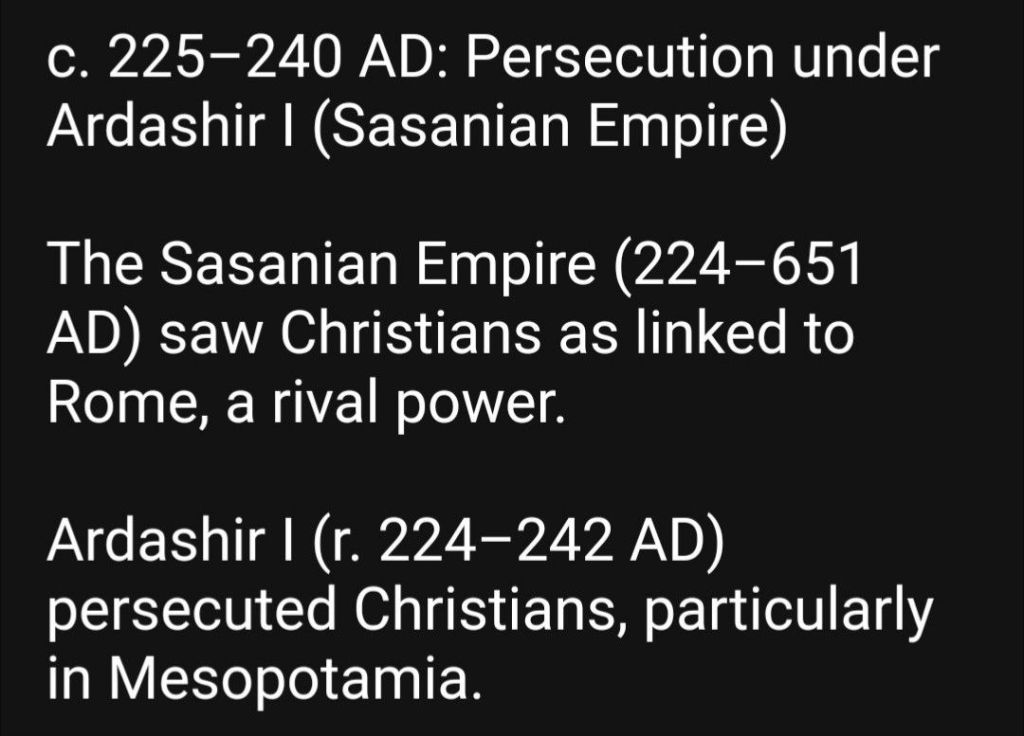
One has to understand also that Novatian, to make his decision, had the knowledge of the lived history of 180 years of persecution not only under the Romans but beyond their Empire. By the 200s (in the lifetime of Novatian) we also find the first documented martyrdoms of christian members of Persian society. For the church to reach these other Empire’s aside from Rome, and grow to the extent that it is persecuted on a wide scale with execution and pogroms, it is clear that disciples persecuted by the Romans, were able to take the opportunity to flee to the Persian churches and on arrival, to use the same formula to convert first Persian Jews, and then the Zoroastrian gentiles. Jews had been living in Persia from the time of Daniel (6th century BC) and the christians arriving from the 1st to the 5th century AD would have been reinforcing the work of Pentacost (32AD) when Jewish ‘Parthians, Medes and Elamites; residents of Mesopotamia” were baptised (Acts 2:9). These Jews had already been living in communities across the Persian Empire since the first deportation on 16/03/597 BC some 800+ years before the first recorded Persian christian martyrs in the 3rd century. In Persia, the Jews had survived genocide and slaughtered their enemies under the protective edict of King Xerxes (470s-480s BC – Esther 9). They were converted to disciples of Christ in Jerusalem in 32 AD and their churches were widespread across the Persian Empire by the 400s. The highly educated and academically minded Novatian would have been well aware of all this. Indeed he wrote to many other churches to ask them not to re-admit those who recanted. We know from the Persian Syriac account of the martyrdom of Simeon and the old eunuch Gushtazad (executed by King Shapur) from the 400’s, that by recanting, one gave up one’s salvation. So this Christian teaching was not only in the Roman Empire but also in the Persian Empire to the East!
The age old accountability of leadership to die the death.
When we look at Novation and even Simeon of Persia and state organised persecution we see that there were many people calling themselves christians bowing to the sun in Persia or worshiping the Roman gods across that Empire to get their piece of paper and preserve their life, thus denying Jesus and the scriptures.
Novatian said that Christianity was not the kind of religion, that had members who could easily lie about their beliefs, even to preserve their life. And he believed that once one had lied in that way, they could not bring the lie back into the church. He could not permit Jesus words to be nullified.
Emperor Decius wanted to wipe out all other religions from the Empire and his Edict in 250AD made the rule of Christianity forbidding idol worship, illegal. If Novatian had allowed disciples to believe they could lie to the Romans he would have undone the work of the cross where Jesus did nothing to avoid his execution by the Romans. Similarly, he would have nullified the martyrdom of the 10 of the 12 Apostles who were martyred. Novatian (and Donatus) would not let public idolatry be brought into the church.
Let’s talk about paedophiles again.
In 1997, I was a Sunday school teacher at a church in London. One day, a man aged between 50 and 55, who had a history of mental health challenges, began attending the church. He was eventually baptized and showed a strong interest in teaching children in the Sunday school. However, the church had a child protection policy that required anyone working with children to be police-screened and a member of the church for at least six months.
Although he did not meet the requirements to become a Sunday school teacher, I received permission to allow him to visit the class briefly. He was given five minutes to share information about the Bible. Afterward, one of the women assisting in the class expressed strong concerns about his behavior and demeanor toward the children. He had not been allowed to in any way touch the children and did not say anything inappropriate to them. Her suspicions were just around his body language and general demeanor which, once she brought it up with me, I could fully understand.
Taking her concerns seriously, I reported the matter to the deacon responsible for the children’s ministry. After careful consideration, a decision was made to prohibit the man from any future involvement with the children. This decision was handled with discretion and compassion.
Over the following years, the man continued attending the church but was involved in inappropriate sexual conduct of an abusive nature with church members he lived with and eventually left. During this time, he then also began cross-dressing publicly and visiting other churches while identifying as female. His mental health deteriorated further, and he was later found (by a visiting disciple raising the alarm) to have died by suicide in his apartment.
This experience, while handled professionally and with care, serves as a reminder of the importance of vigilance in protecting children in church environments. It underscores the need for robust safeguarding policies to ensure that only suitable individuals are allowed access to vulnerable members of the community. Additionally it shows that in my church in particular, we took genuine concerns and intuitions of those women looking after the children into serious consideration. This actually goes above and beyond what is legally necessary. I believe we did the right thing. As someone who was sexually abused by a leader in the Roman Catholic church I grew up in, I was proud to be a part of these and other events protecting children.
I understand the need for and protective nature of the rulings of Novatian and Donatus not to readmit those who recant during state organised persecutions.
Chinese Proverb
“Fool me once, shame on you; fool me twice, shame on me.”

 Morganite's Blog